I believe Firetail has a decent chance of becoming an enduring, values-driven, independent firm.
But to do that, it needs to develop beyond its founder, whilst keeping the culture that makes it special.
Ben becoming CEO is a massive step in that direction. He has already proven himself to be an exceptionally capable leader, and he’s supported by a great team. I’m delighted he’s taken it on.
I’ll become Chair and stay closely involved where I’m needed. I’m still around if anyone wants to get in touch. Most importantly, I’m really excited by this move, and the possibilities unlocked by giving Ben and the team the space to lead the firm.
Becoming a B Corp has delivered practical benefits I did not expect.
Firetail has always been a business with purpose at its heart. Several years ago we made that commitment formal by becoming a B Corp.
There are the obvious benefits. It gives us brand credibility and connected us to a global community trying to do business better.
As it’s #bcorpmonth, I wanted to share the three things I did not anticipate, that have made the biggest practical difference to the business.
1. Accountability and consistency.
It forced us to be more disciplined.
B Corp pushed us to properly codify things like governance, impact reporting and how we think about our responsibilities to staff, clients, and society. Writing these things down, measuring them, and being held accountable made us more consistent, and better run.
2. Procurement and credibility.
It has helped us to win work.
B Corp certification is a credible indicator of how a business operates. We have definitely won projects we might otherwise have lost, particularly in competitive tenders where trust and values matter.
In several cases, our clients have awarded additional points in procurement processes to firms with the certification.
3. Staff and recruitment.
It helps us to attract talented people.
B Corp status resonates strongly in recruitment, especially with people at the start of their careers. For a small firm without a huge brand presence, it gives us a genuine edge when engaging people who want their work to mean something.
Becoming a B Corp is not just a badge. It has shaped how we run the business, how we win work, and how we build our team.
Firetail is a certified B Corp — but we’re also members of 1% for the Planet, the corporate giving initiative founded by Patagonia. It commits companies to give 1% of their revenue to vetted environmental causes.
Yvon Chouinard is one of my business heroes, and “Let My People Go Surfing” was a big inspiration for me to start my own company.
Each of them is doing inspiring work supporting communities — from protecting rainforests and rebuilding food systems to regenerating oceans and expanding solar access.
1% is intentionally a hands-off model. There’s no bureaucracy and all the giving is unrestricted. But it can be surprisingly hard to give the money away. And most charities aren’t even registered with platforms like this.
At a time when new income is hard to come by, it feels like there’s a big underserved opportunity in SME giving. These are small tickets, but it’s a big and growing opportunity. Helping purpose-driven SMEs discover and support causes aligned to their values feels like a problem worth solving.
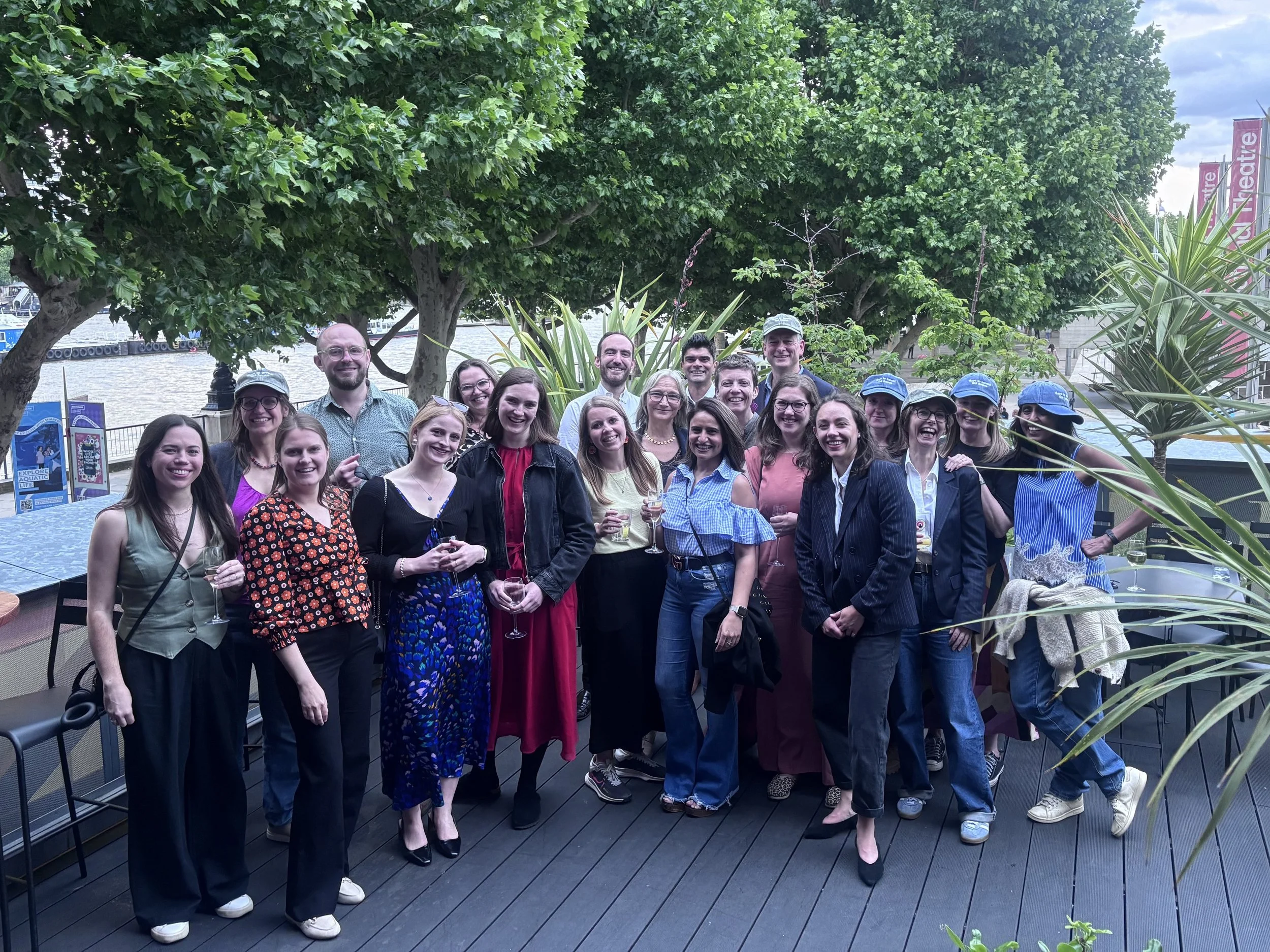
In June, we marked Firetail’s 20th anniversary—a moment that invited both celebration and reflection. We had a small drinks party at the BFI to celebrate with the team, alumni, partners and friends.
This post is adapted from a short speech I gave. It shares some thoughts on why I started the business, what’s kept us going, and what it means to me to be able to work with people committed to long-term impact.
And if you’ve ever been part of Firetail’s journey—client, colleague, friend—thank you.
Reflecting on 20 years
I set Firetail up with three ambitions:
To work with the best people I could,
To work with people trying to make a difference in the world,
For Firetail to be a place where people enjoyed coming to work.
Those ambitions, that I set in my twenties, I have more or less repeated every year for 20 years.
Initially, it was just me and the dog, and now it’s this incredibly talented team. But it’s been more or less the same plan the whole time.
The importance of celebrating the long-term
Almost the only reason to celebrate an anniversary is to appreciate the people we have had the chance to work with. Firetail has been able to work on such interesting and important issues – from climate change to stem cell transplantation, from digital rights to drug and alcohol support, and all points in between.
A common feature of the people we’ve worked with, and the issues we’ve worked on, is a real, long term commitment to their work.
As a society — and among the organisations we work with — people get very excited about scale. Usually, scale means reach: share, size, coverage, visibility. speed. How quickly we can get big?
We rarely think of scale in terms of duration, or in terms of endurance.
We don’t celebrate the quiet, long-term, deep commitment over decades that I have seen from the people we have worked alongside. We don’t celebrate endurance enough.
That is impact at scale, too.
Everyone we invited to celebrate with us is a long term person. People driven by the right things, working on hard problems, in the right way. We’ve been very lucky to work alongside these people.
Firetail Team and Alumni
There are no secrets to endurance. As a team, we’ve always done our best. We’ve always taken the work seriously, but not ourselves — and we kept showing up.
That third part of the business plan — being a good place to work — we’ve done our best.
The trick, really, has been to hire great people — and it was special to see so many join us to celebrate. I’m so proud of the journeys people went on with us, and what they’ve gone on to do.
I bask in the reflected glory of everyone’s success.
We must dare to invent the future
As much as we celebrate the past, it’s important to look to the future.
Many of the organisations we work with are facing tough times. There’s a lot of difficult news out there. It’s really hard. At a time when it’s tempting to be negative, easy to feel overwhelmed or uncertain, we have to keep believing that the work we do matters and be ready to tackle uncertainty head on.
Some people will have heard me talking recently about Thomas Sankara — the revolutionary leader of Burkina Faso in the 1980s. A fascinating character. Heroic, somewhat forgotten today.
He talked about change needing courage. The courage to turn your back on old formulas, the courage of nonconformity. The courage to pursue what you think is right.
And he said — and it’s a phrase I love:
“We must dare to invent the future.”
It’s a great challenge. A reminder that the future is something within our power to build.
It’s such a great quote that I put it on a hat, to remind you that this is your job.
So to everyone we have worked with or worked for — and for all of you out there daring to invent the future — you are amazing. I’ve seen you achieve real change in the world. I will keep doing this as long as I still have the chance to work with you.
“It ain’t what you don’t know that gets you into trouble. It’s what you know for sure that just ain’t so.”
— Mark Twain*
In this article in the Stanford Social Innovation Review, Firetail CEO Andy Martin and Kecia Bertermann explore the challenge of “disconfirming evidence” and why it matters in grant making and philanthropy. Other sectors have tools, structures and cultural norms to tackle confirmation bias. Grantmaking and philanthropy seems much less mature, which presents a real opportunity for the sector.
Embracing uncertainty and the iterative nature of philanthropic work can lead ultimately, to greater impact.
Most of Firetail’s work is the kind of foundational, long-term strategy work that rarely makes headlines, so I don’t normally get to celebrate the work of the team. But in the last couple of weeks, a few things have been published that we’ve been working on for a while:
– The RSPCA’s “Animal Futures” report is an innovative and creative scenario planning project, connecting animal welfare to the broader social, environmental and technological changes facing the world through to 2050. Chris Sherwood, Emma Slawinski and everyone at the RSPCA deserve so much credit for such a bold programme of work. – The Royal Society‘s report on the future of mathematical and data education is a call for reform. We worked with the Mathematical Futures Programme to explore how to provide a better mathematical education for everyone. – The Royal Pharmaceutical Society’s decision to transition to a Royal College—an important milestone for the profession—was informed by our organisational review and recommendations.
And this is just what’s public this month. We’re currently working with clients in climate, science, medical research, international development and community services.
Whilst It’s rewarding when our clients choose to share the results, the best part of this job is getting to work with smart, ambitious people trying to make a meaningful impact in the world.
We’re a small team and our work plays out quietly in the world in lots of different ways. I’m really proud of the Firetail team, but I’m especially grateful to all of our clients for trusting us to play a part in their important work.
In recent conversations with our mission-driven clients and partners, a recurring theme has emerged: a feeling of disengagement and disconnection from the forces and conversations shaping the future.
This is understandable. Organisations are under pressure, balancing tight resources with increasing need. People are less focussed on shaping the future, and more focussed on surviving the present.
But if you don’t create the future, who will?
If the general sense within your organisation is that everything is getting worse and nothing can be done about it, then you might have a Futures Gap.
As the team looked back on the last year, we reflected on two themes which consistently emerged in our most interesting conversations. These themes surfaced in our work on climate, health, scientific research, humanitarianism, and other areas.
If these themes are related, it is because they ask questions beyond the scope of what is normally expected from “strategy”, even for organisations focused on social impact. Most strategy is about organisations and most strategy is rational (or at least pretends to be).
The strategic questions that kept coming up in 2023 were about networks and emotions. They invited us to think about pace, agency and power. These questions shift the focus of strategy from a single, rational organisation. They ask us to look outwards to the network, and inwards towards the personal.
We are delighted to announce that we are now officially certified as a B Corp.
Firetail was set up to help clients working on the world’s most challenging problems. Our purpose is to help impact-driven organisations realise their ambitions for society.
Certification is an important achievement for us as a business, as a team, and for our clients and partners. As we celebrate joining this movement, we wanted to explain why being B Corp Certified is important to us and how we got here.
A “theory of the state” can be thought of as a clear idea of the society you want, and the role of government in making it happen.
Charities should have a clear “theory of the state” that describes how their relationship with the state supports their wider theory of change.
Thinking about the role you play as a charity relative to the state is likely to be critical in the face of cuts to public services and the wider crises facing the world.