
Dare to invent the future: Reflections on 20 years of Firetail

In June, we marked Firetail’s 20th anniversary—a moment that invited both celebration and reflection. We had a small drinks party at the BFI to celebrate with the team, alumni, partners and friends.

This post is adapted from a short speech I gave. It shares some thoughts on why I started the business, what’s kept us going, and what it means to me to be able to work with people committed to long-term impact.

And if you’ve ever been part of Firetail’s journey—client, colleague, friend—thank you.

Reflecting on 20 years

I set Firetail up with three ambitions:

  • To work with the best people I could,
  • To work with people trying to make a difference in the world,
  • For Firetail to be a place where people enjoyed coming to work.

Those ambitions, that I set in my twenties, I have more or less repeated every year for 20 years.

Initially, it was just me and the dog, and now it’s this incredibly talented team. But it’s been more or less the same plan the whole time. 

The importance of celebrating the long-term

Almost the only reason to celebrate an anniversary is to appreciate the people we have had the chance to work with. Firetail has been able to work on such interesting and important issues – from climate change to stem cell transplantation, from digital rights to drug and alcohol support, and all points in between.

A common feature of the people we’ve worked with, and the issues we’ve worked on, is a real, long term commitment to their work.

As a society — and among the organisations we work with — people get very excited about scale. Usually, scale means reach: share, size, coverage, visibility. speed.  How quickly we can get big?

We rarely think of scale in terms of duration, or in terms of endurance.

We don’t celebrate the quiet, long-term, deep commitment over decades that I have seen from the people we have worked alongside. We don’t celebrate endurance enough. 

That is impact at scale, too.

Everyone we invited to celebrate with us is a long term person. People driven by the right things, working on hard problems, in the right way.  We’ve been very lucky to work alongside these people.
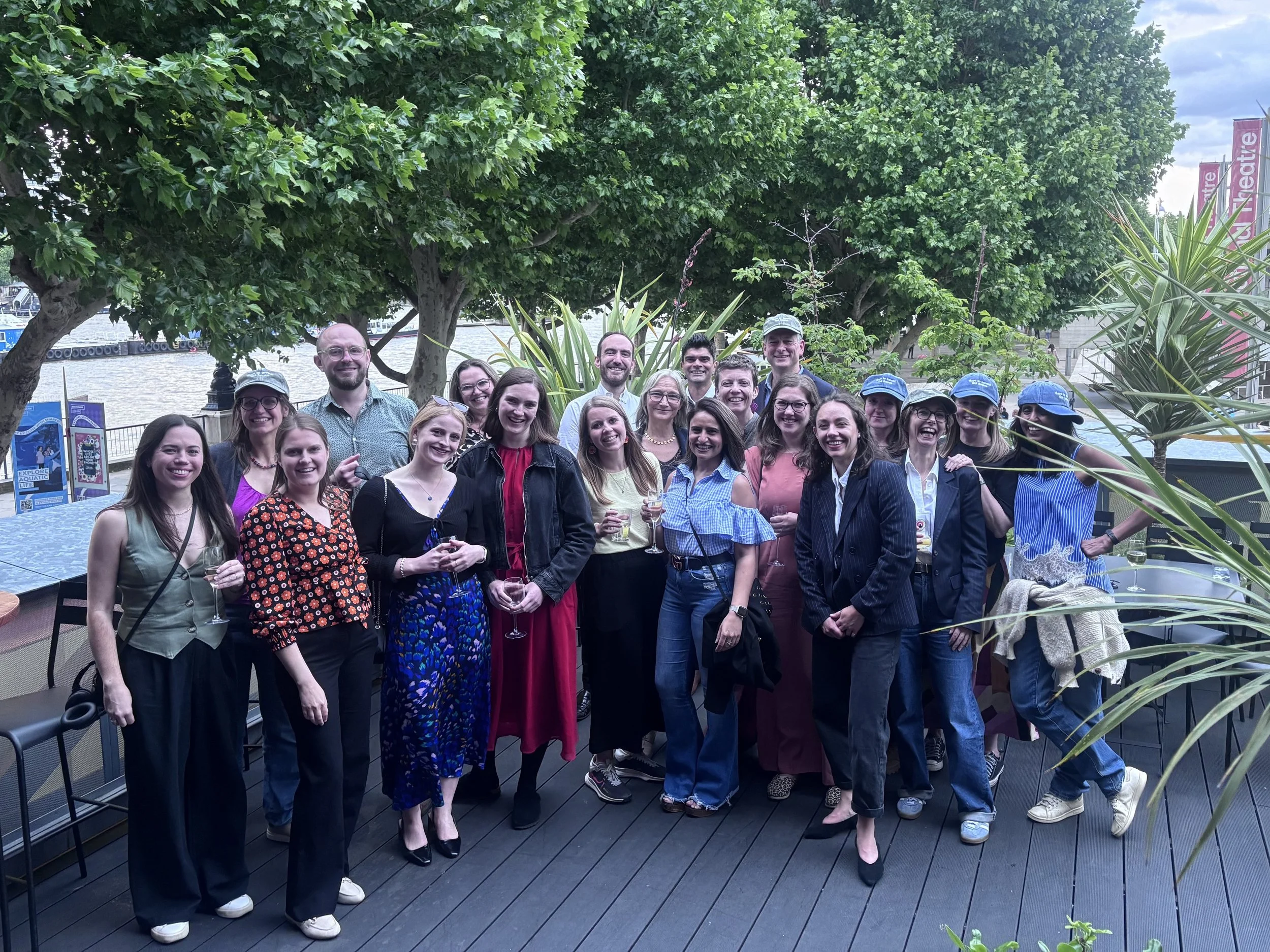
Firetail Team and Alumni

There are no secrets to endurance. As a team, we’ve always done our best. We’ve always taken the work seriously, but not ourselves — and we kept showing up.

That third part of the business plan — being a good place to work — we’ve done our best. 

The trick, really, has been to hire great people — and it was special to see so many join us to celebrate. I’m so proud of the journeys people went on with us, and what they’ve gone on to do.

I bask in the reflected glory of everyone’s success.

We must dare to invent the future

As much as we celebrate the past, it’s important to look to the future.

Many of the organisations we work with are facing tough times. There’s a lot of difficult news out there. It’s really hard. At a time when it’s tempting to be negative, easy to feel overwhelmed or uncertain, we have to keep believing that the work we do matters and be ready to tackle uncertainty head on.

Some people will have heard me talking recently about Thomas Sankara — the revolutionary leader of Burkina Faso in the 1980s. A fascinating character. Heroic, somewhat forgotten today.

He talked about change needing courage. The courage to turn your back on old formulas, the courage of nonconformity.  The courage to pursue what you think is right.

And he said — and it’s a phrase I love:

“We must dare to invent the future.”

It’s a great challenge. A reminder that the future is something within our power to build. 

It’s such a great quote that I put it on a hat, to remind you that this is your job. 

So to everyone we have worked with or worked for — and for all of you out there daring to invent the future — you are amazing. I’ve seen you achieve real change in the world. I will keep doing this as long as I still have the chance to work with you.

Thank you.

On disconfirming evidence

“It ain’t what you don’t know that gets you into trouble. It’s what you know for sure that just ain’t so.”

— Mark Twain* 

In this article in the Stanford Social Innovation Review, Firetail CEO Andy Martin and Kecia Bertermann explore the challenge of “disconfirming evidence” and why it matters in grant making and philanthropy. Other sectors have tools, structures and cultural norms to tackle confirmation bias. Grantmaking and philanthropy seems much less mature, which presents a real opportunity for the sector.

Embracing uncertainty and the iterative nature of philanthropic work can lead ultimately, to greater impact.

Read the article here.

September: Updates from Firetail

Most of Firetail’s work is the kind of foundational, long-term strategy work that rarely makes headlines, so I don’t normally get to celebrate the work of the team. But in the last couple of weeks, a few things have been published that we’ve been working on for a while:

– The RSPCA’s “Animal Futures” report is an innovative and creative scenario planning project, connecting animal welfare to the broader social, environmental and technological changes facing the world through to 2050. Chris Sherwood, Emma Slawinski and everyone at the RSPCA deserve so much credit for such a bold programme of work.
The Royal Society‘s report on the future of mathematical and data education is a call for reform. We worked with the Mathematical Futures Programme to explore how to provide a better mathematical education for everyone.
– The Royal Pharmaceutical Society’s decision to transition to a Royal College—an important milestone for the profession—was informed by our organisational review and recommendations.

And this is just what’s public this month. We’re currently working with clients in climate, science, medical research, international development and community services.

Whilst It’s rewarding when our clients choose to share the results, the best part of this job is getting to work with smart, ambitious people trying to make a meaningful impact in the world.

We’re a small team and our work plays out quietly in the world in lots of different ways. I’m really proud of the Firetail team, but I’m especially grateful to all of our clients for trusting us to play a part in their important work.

Do you have a “Futures Gap”?

In recent conversations with our mission-driven clients and partners, a recurring theme has emerged: a feeling of disengagement and disconnection from the forces and conversations shaping the future. 

This is understandable. Organisations are under pressure, balancing tight resources with increasing need. People are less focussed on shaping the future, and more focussed on surviving the present.

But if you don’t create the future, who will?  

If the general sense within your organisation is that everything is getting worse and nothing can be done about it, then you might have a Futures Gap.

Continue reading “Do you have a “Futures Gap”?”

Two difficult strategy questions for 2024

As the team looked back on the last year, we reflected on two themes which consistently emerged in our most interesting conversations. These themes surfaced in our work on climate, health, scientific research, humanitarianism, and other areas.

If these themes are related, it is because they ask questions beyond the scope of what is normally expected from “strategy”, even for organisations focused on social impact. Most strategy is about organisations and most strategy is rational (or at least pretends to be).

The strategic questions that kept coming up in 2023 were about networks and emotions. They invited us to think about pace, agency and power. These questions shift the focus of strategy from a single, rational organisation. They ask us to look outwards to the network, and inwards towards the personal.

Continue reading “Two difficult strategy questions for 2024”

Firetail is now a B Corp

We are delighted to announce that we are now officially certified as a B Corp.

Firetail was set up to help clients working on the world’s most challenging problems. Our purpose is to help impact-driven organisations realise their ambitions for society.

Certification is an important achievement for us as a business, as a team, and for our clients and partners. As we celebrate joining this movement, we wanted to explain why being B Corp Certified is important to us and how we got here.

Continue reading “Firetail is now a B Corp”

What is your “theory of the state”?

  • A “theory of the state” can be thought of as a clear idea of the society you want, and the role of government in making it happen.
  • Charities should have a clear “theory of the state” that describes how their relationship with the state supports their wider theory of change.
  • Thinking about the role you play as a charity relative to the state is likely to be critical in the face of cuts to public services and the wider crises facing the world.
Continue reading “What is your “theory of the state”?”

Common mistakes and practical lessons for developing a Theory of Change

A Theory of Change can be a powerful tool. It can tell the story of how the world can be a better place, what it will take to get there, and how you are going to help make it happen.  

Yet in practice they are often “nice-to-have”. An abstract academic exercise that has little impact on the day to day challenges of running a social progress organisation.

Over the years we have developed a tried and tested approach to take teams through a process to deliver a Theory of Change that is practical and useful.

This article shares four common mistakes, and four lessons learned about doing it well and making it stick.

Continue reading “Common mistakes and practical lessons for developing a Theory of Change”

Is it time to abolish the Charity Commission?

The Charity Commission is the regulator for charities in England and Wales. It is funded by the Treasury but independent of government.

Its purpose is:

To ensure charity can thrive and inspire trust so that people can improve lives and strengthen society.”

It is both the registrar of charities and regulator of charities. Which means it keeps a list of all the charities and investigates the bad ones. It deals with complaints, helps trustees be good trustees and occasionally shares its opinion about “charity”.

It does all this — keeps a list of around 170,000 charities and regulates £81.2bn of charity income — on a budget of £29.3m.

So for every £1,000 of charity income in England and Wales, 36p is spent on regulation by the Charity Commission.

As the tenure of the current Chair comes to an end, others have written thoughtful articles about the skills the incoming Chair should have. However, the problem goes deeper than the person at the top and has for some time.

It may be time to abolish the Charity Commision.

Continue reading “Is it time to abolish the Charity Commission?”

Beyond fundraising: New business models for social progress

We recently wrote about the death of fundraising and the threat to traditional ideas of charity as people embed ideas of impact and purpose into every aspect of their lives.

As with other long-term trends, this accelerated during the pandemic. Everything has become fluid. Governments have made unprecedented interventions and businesses are getting serious about their social purpose. Charities in the UK have asked for (and mostly not got) additional support. 

This raises some big questions. What is the proper role and relationship between the state and charities? Between business and charity? What can these sectors learn from each other? What’s the role for the voluntary sector if more and more “non-charities” are moving into this space? What’s the difference between a charity that earns some of its income and a business with a social purpose? Does it even matter?

Importantly – and practically – should charities stay in their lane when no-one else is?

Continue reading “Beyond fundraising: New business models for social progress”